
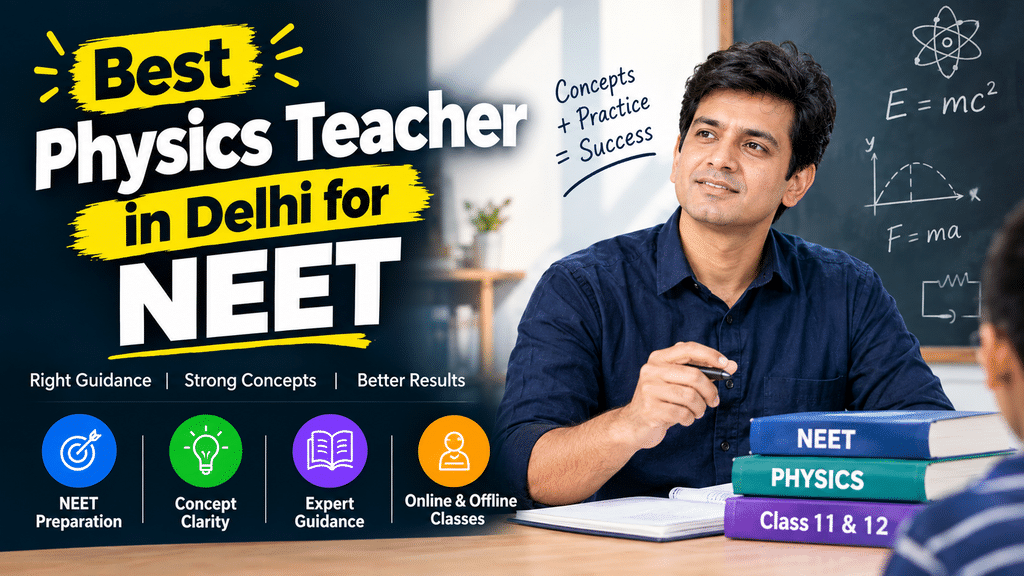
For many NEET aspirants, Physics is the subject that requires the most patience. Biology often involves learning a large amount of information, while Chemistry combines theory, reactions and numerical problems. Physics requires students to understand concepts and apply them correctly to solve questions.
A student may understand a chapter during class but still struggle when attempting questions independently. Sometimes the problem is not a lack of effort. It may be an unclear concept, weak mathematical basics or insufficient practice with different types of questions.
This is why choosing the best Physics teacher in Delhi for NEET is an important decision for students preparing for medical entrance examinations.
The right teacher can help students understand difficult topics, develop a systematic approach to numerical problems and identify mistakes before they become habits.
Why Do NEET Students Find Physics Difficult?
Physics can become challenging when students try to memorise formulas without understanding the ideas behind them.
Consider a question from Laws of Motion. A student may remember Newton’s second law, but applying it correctly requires identifying the forces acting on an object and understanding the situation described in the question.
Similar difficulties appear in Current Electricity, Electrostatics, Magnetism and other chapters.
Some common reasons students struggle with NEET Physics include:
- Weak understanding of fundamental concepts
- Difficulty converting a word problem into equations
- Confusion about which formula to apply
- Errors in calculations and units
- Limited practice with previous-year questions
- Forgetting concepts because of irregular revision
- Spending too much time on a single numerical problem
These problems can be addressed through clear explanations, regular practice and a consistent revision routine.
What Should You Look for in a NEET Physics Teacher?
Choosing a teacher should involve more than looking at popularity or promotional claims. Students need someone whose teaching style matches their learning requirements.
A teacher who explains the reasoning
A good Physics lesson should explain why a formula works, what the variables represent and under which conditions it can be used.
When students understand the reasoning, they are better prepared to solve questions that look different from the examples discussed in class.
A practical approach to numerical questions
NEET Physics preparation requires students to apply concepts under examination conditions. A teacher should demonstrate how to read a question, identify the relevant information, select the correct principle and solve the problem step by step.
Students should also learn to recognise common calculation errors and avoid unnecessary steps.
Regular doubt-solving
A small misunderstanding in one chapter can create difficulties in later topics. Students should feel comfortable asking questions and revisiting concepts they have not understood.
Regular doubt-solving helps prevent these gaps from affecting further preparation.
A balance between concepts and practice
Watching lectures alone is not enough. Students need to solve questions independently, review incorrect answers and practise applying the same concept in different situations.
A useful learning routine combines explanation, guided examples, independent practice and revision.
Meet Zayn Tabish: Physics Faculty for NEET Preparation in Delhi
Zayn Tabish is a Physics faculty member with more than 15 years of teaching experience. His teaching background includes working with established coaching institutes such as Aakash, Vidyamandir Classes (VMC) and FIITJEE in New Delhi.
His teaching focuses on helping students develop a clear understanding of Physics concepts and improve their approach to numerical problem-solving.
For NEET aspirants, this means working on the fundamentals before progressing to more demanding questions. Students need to understand the principles behind a problem rather than depend entirely on memorised methods.
Zayn Tabish provides Physics teaching for school students and competitive examination aspirants, including those preparing for NEET.
Students looking for Physics classes in Delhi NCR can explore his teaching approach and determine whether it suits their academic goals.
How to Approach NEET Physics Chapter by Chapter
A common mistake is to study Physics without a clear plan. Students may spend several hours on a difficult chapter while leaving previously studied topics unrevised.
A more organised approach can make preparation manageable.
Step 1: Understand the basic concept
Begin with the central idea of each topic. For example, before solving complex questions on electric circuits, understand current, potential difference, resistance and the relationships between them.
Do not move forward simply because you have finished reading the chapter. Check whether you can explain the concept in your own words.
Step 2: Learn formulas through their applications
Maintain a formula notebook, but avoid turning it into a list of equations that you memorise without context.
For each important formula, write down what the symbols mean, the conditions under which it applies and one example of its use.
This makes revision more useful when you encounter unfamiliar questions.
Step 3: Practise questions at different levels
Start with basic questions to check your understanding. Then progress to questions that require multiple steps or combine different concepts.
If you cannot solve a question, identify exactly where you became stuck. Was the concept unclear? Did you select the wrong equation? Was there a calculation error?
Finding the reason for a mistake is more valuable than simply checking the correct answer.
Step 4: Solve previous-year questions
Previous-year NEET questions help students become familiar with the examination’s question style and the way concepts are tested.
After completing a chapter, attempt relevant questions without immediately checking the solutions. Review your answers afterwards and note the concepts that need more attention.
Use official examination resources and reliable question papers wherever possible.
Step 5: Revise consistently
Revision should be part of the preparation plan from the beginning.
Review formulas, important concepts and previously incorrect questions at regular intervals. As the examination approaches, include timed practice and full-length mock tests in your routine.
Important Physics Topics for NEET Preparation
The entire syllabus deserves appropriate attention. Students should not depend on predictions about which chapters will appear in the examination.
Some major areas students commonly work on include:
- Mechanics: Motion, Laws of Motion, Work and Energy, Rotational Motion and Gravitation
- Thermal Physics: Thermodynamics and related concepts
- Electricity and Magnetism: Electrostatics, Current Electricity, Magnetic Effects and Electromagnetic Induction
- Optics: Ray Optics and Wave Optics
- Modern Physics: Atomic and Nuclear Physics and other topics included in the prescribed syllabus
- Waves and Oscillations: Fundamental principles and their applications
The exact preparation plan should follow the official NEET syllabus for the relevant examination year. Students should also check the current information bulletin for the latest examination requirements.
How Can Students Improve Their Physics Score?
Improving in Physics usually requires identifying weaknesses rather than increasing study hours without a plan.
A student who makes frequent calculation errors needs a different solution from someone who does not understand the underlying concepts.
Try maintaining a simple mistake record with three categories:
Concept mistakes: You did not understand the principle required to solve the question.
Application mistakes: You knew the concept but could not decide how to use it.
Calculation mistakes: Your approach was correct, but an arithmetic, sign or unit error affected the answer.
Review this record every week. It can help you decide which chapters and skills need more attention.
Also, avoid judging your preparation using only one mock-test score. Look at your accuracy, time management, repeated mistakes and progress across several tests.
Is Coaching Necessary for NEET Physics?
Not every student needs the same kind of support. Some students can study independently with textbooks, question banks and a well-planned revision schedule. Others benefit from classroom teaching, structured lessons and regular doubt-solving.
A Physics teacher can be especially helpful when a student repeatedly struggles with the same concepts or cannot work out why their answers are incorrect.
Before joining a class, students should understand the teaching method, practice schedule, doubt-solving arrangements and course coverage.
The aim should be to develop independent problem-solving skills, not permanent dependence on a teacher.
Online and Offline NEET Physics Classes in Delhi NCR
Students have different preferences when it comes to learning.
Offline classes provide direct classroom interaction, while online classes can offer flexibility for students who prefer studying from home or have difficulty travelling regularly.
Zayn Tabish offers Physics teaching through online and offline modes in Delhi NCR. Students can consider the available learning format according to their location, schedule and academic needs.
Whichever mode they choose, regular attendance, independent question practice and timely revision remain essential.
Frequently Asked Questions
Who is the best Physics teacher in Delhi for NEET?
The right teacher depends on the student’s learning needs, teaching preferences and preparation level. Students should compare teaching experience, concept clarity, practice methods and doubt-solving support before making a decision. Zayn Tabish is a Physics faculty member with 15+ years of teaching experience, including experience at Aakash, VMC and FIITJEE in New Delhi.
How can I improve my NEET Physics preparation?
Start by strengthening fundamental concepts, practise numerical questions regularly and analyse your mistakes. Include previous-year questions, revision and timed mock tests in your study schedule.
Is NCERT enough for NEET Physics?
NCERT is an important resource for understanding Physics fundamentals and should be studied carefully. However, students also need to practise numerical questions and examination-style problems according to the prescribed syllabus and their preparation needs.
When should I start preparing for NEET Physics?
Starting early gives students more time to understand concepts, practise questions and revise. However, students at different stages can still improve by making a realistic plan based on the time remaining and the topics they need to cover.
Does Zayn Tabish teach NEET Physics in Delhi?
Zayn Tabish provides Physics teaching for competitive examination aspirants and students in Delhi NCR, with online and offline learning options.
Final Thoughts
Preparing for NEET Physics is not just about remembering formulas or solving as many questions as possible. Students need to understand the concepts, apply them correctly and learn from their mistakes.
When choosing the best Physics teacher in Delhi for NEET, look for a teaching approach that makes difficult topics easier to understand and gives you enough opportunity to practise independently.
With a clear study plan, consistent revision and suitable guidance, students can work towards improving their Physics preparation and approaching the NEET examination with greater confidence.
About Zayn Tabish: Zayn Tabish has 15+ years of Physics teaching experience and has worked with Aakash, VMC and FIITJEE in New Delhi. His teaching areas include school Physics, Foundation, NEET and JEE preparation.