
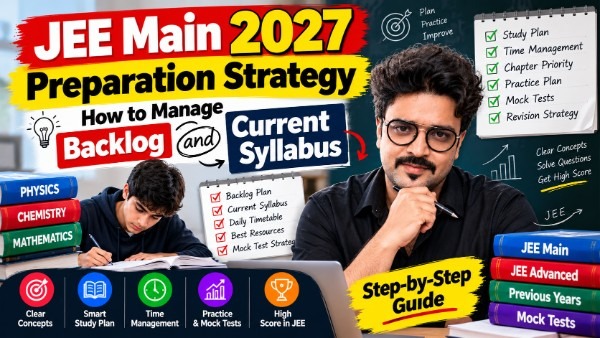
Are you preparing for JEE Main 2027 but still have many chapters left from Class 11 or Class 12? Do you feel that your coaching classes are moving ahead while your backlog keeps increasing?
Many JEE aspirants face this problem. They attend regular classes, watch lectures, and make notes, but still struggle to complete their syllabus on time.
The biggest challenge is deciding what to study first. Should you complete your old chapters or focus on the current syllabus? Should you watch one-shot lectures or detailed classes? How can you prepare for JEE Main 2027 when you have limited time?
The good news is that you can still improve your preparation with a realistic study plan.
In this guide, you will learn how to manage your JEE Main 2027 backlog, complete important chapters, balance Physics, Chemistry, and Mathematics, and improve your performance through regular practice.
1. Understand the JEE Main 2027 Syllabus Before Making a Study Plan
Before preparing your timetable, understand what you actually need to study.
JEE Main Paper 1 (B.E./B.Tech.) covers three subjects:
- Physics
- Chemistry
- Mathematics
The official JEE Main 2027 syllabus includes topics from Class 11 and Class 12. It covers 20 Physics units, 20 Chemistry units, and 14 Mathematics units.
You can check the official syllabus here:
JEE Main 2027 Official Syllabus – NTA
Download the syllabus and compare it with your preparation.
Make three lists:
| Preparation status | Meaning | What to do |
|---|---|---|
| Completed | You understand the concepts and can solve questions | Continue revision and PYQs |
| Partially completed | You understand some topics but struggle with others | Revise weak concepts and practise |
| Not started | You have not studied the chapter properly | Start with prerequisite concepts |
This simple exercise will help you identify your actual backlog instead of worrying about the entire syllabus.
2. How to Manage JEE Main 2027 Backlog and Current Syllabus Together
One of the biggest mistakes students make is ignoring their current syllabus while trying to finish old chapters.
Suppose your coaching is teaching Current Electricity, but you still have a backlog in Newton’s Laws of Motion.
If you stop attending current classes, you may create another backlog.
A better approach is to study both.
Follow the 60:40 Study Method
As a starting point, divide your available self-study time into:
- 60% for the current syllabus: Attend lectures, revise concepts, and complete homework.
- 40% for backlog: Study pending chapters and practise questions.
For example, if you have five hours for self-study:
| Activity | Time |
|---|---|
| Current syllabus study | 2 hours |
| Current chapter questions | 1 hour |
| Backlog concepts | 1 hour |
| Backlog questions and revision | 1 hour |
This is a flexible example, not a fixed rule.
If you are a dropper or your regular syllabus is already complete, you may need to spend more time on backlog and mock tests.
3. Which Chapters Should You Complete First for JEE Main 2027?
Do not select chapters only because they look easy or have appeared frequently in previous exams.
Prioritise chapters based on three factors:
- How important they are for understanding other chapters.
- How weak your current understanding is.
- How much time you need to complete them.
Physics Chapters to Strengthen
If your Physics foundation is weak, consider starting with:
- Units and Measurements
- Kinematics
- Laws of Motion
- Work, Energy and Power
- Electrostatics
- Current Electricity
- Optics
- Atoms and Nuclei
For example, Kinematics and Laws of Motion provide a foundation for many mechanics problems.
However, you should not ignore other syllabus units. Your final preparation must cover the official syllabus as thoroughly as your available time allows.
Chemistry Chapters to Strengthen
Focus on understanding topics such as:
- Some Basic Concepts in Chemistry
- Atomic Structure
- Chemical Bonding
- Chemical Thermodynamics
- Equilibrium
- Some Basic Principles of Organic Chemistry
- Coordination Compounds
- Chemical Kinetics
Chemistry requires a combination of conceptual understanding, numerical practice, and regular revision.
Mathematics Chapters to Strengthen
Important areas to work on include:
- Sets, Relations and Functions
- Quadratic Equations
- Trigonometry
- Sequence and Series
- Limits, Continuity and Differentiability
- Integral Calculus
- Coordinate Geometry
- Vector Algebra and Three-Dimensional Geometry
Mathematics improves through regular question-solving. Simply watching lectures will not be enough.
4. JEE Main 2027 Preparation Strategy from October
If you are preparing in October 2026, your first priority should be to identify weak chapters and make the best use of the remaining preparation time.
Instead of trying to finish everything immediately, divide your preparation into three phases.
Phase 1: Identify Weak Areas and Repair Your Foundation
Suggested duration: 2 weeks
During this phase:
- List incomplete chapters.
- Identify prerequisite topics.
- Complete essential concepts.
- Start solving basic and moderate questions.
- Continue studying the current syllabus.
For Physics, begin with the concepts that are preventing you from solving questions in other chapters.
Phase 2: Complete Pending Chapters and Practise PYQs
Suggested duration: 4–6 weeks
Focus on:
- Completing selected pending chapters.
- Solving previous year questions.
- Revising important formulas.
- Practising mixed-topic questions.
- Taking regular chapter tests.
Do not spend all your time watching lectures.
After completing each topic, test whether you can solve questions independently.
Phase 3: Mock Tests, Revision and Accuracy Improvement
Continue until your examination
During the final preparation phase:
- Take timed mock tests.
- Analyse incorrect answers.
- Revise weak concepts.
- Practise questions from completed chapters.
- Improve speed and accuracy.
- Review your short notes regularly.
These phases may overlap. If your backlog is large, you should continue targeted backlog work while taking mock tests.
5. Daily Study Timetable for JEE Main 2027 Aspirants
A timetable should help you stay consistent without creating unnecessary pressure.
Here is an example for students who have around six hours available for focused self-study.
| Time allocation | Task |
|---|---|
| 90 minutes | Physics concepts and numerical practice |
| 90 minutes | Mathematics practice |
| 75 minutes | Chemistry concepts and questions |
| 60 minutes | Backlog chapter |
| 45 minutes | PYQs, error analysis and revision |
Total: 6 hours
Take short breaks between study sessions.
If you attend school or coaching, reduce the hours according to your actual availability. Droppers may follow a different schedule.
The important thing is to make daily progress in all three subjects.
6. How to Clear Your JEE Physics Backlog Effectively
Physics is one of the subjects where many JEE aspirants struggle.
Students often remember formulas but cannot decide which formula to apply in a question.
This happens when the concepts are not clear.
Step 1: Understand the Basic Concept
Before solving questions, understand the meaning of the physical quantities involved.
For example, while studying Newton’s Laws of Motion, learn how forces act on an object and how to draw a free-body diagram.
Step 2: Learn the Formula with Its Application
Do not memorise formulas without understanding their conditions.
For example:
F = ma
This equation relates net force, mass, and acceleration in Newtonian mechanics.
Understanding the concept helps you identify when and how to use the formula.
Step 3: Start with Basic Numericals
Begin with simple questions.
Once you can solve them independently, move towards moderate and more challenging JEE-level problems.
Step 4: Practise Previous Year Questions
After completing a chapter, solve relevant JEE Main previous year questions.
Identify which concepts are repeatedly tested and where you make mistakes.
Step 5: Revise Regularly
Keep a short notebook for formulas, concepts, and mistakes.
Revisit difficult questions after a few days instead of only reading their solutions once.
Need Help with JEE Physics? Learn with Zayn Sir
If you are struggling with Class 11 or Class 12 Physics, difficult numericals, or incomplete concepts, guided learning may help you build a stronger foundation.
Zayn Tabish (Zayn Sir) is a Physics educator with over 15 years of teaching experience. He has taught students at coaching institutes including VMC, Aakash, and FIITJEE.
His Physics classes focus on:
- Concept-based explanations
- Class 11 and Class 12 Physics
- JEE Main and JEE Advanced preparation
- Numerical problem-solving
- Doubt clarification
- Building confidence in difficult topics
Want to improve your Physics preparation for JEE Main 2027?
Visit ZaynTabish.com to explore Physics classes and enquire about booking a session with Zayn Sir.
7. How to Prepare Chemistry and Mathematics Alongside Physics
JEE Main preparation requires a balanced approach.
Chemistry Preparation Strategy
For Chemistry:
- Read NCERT carefully.
- Understand concepts in Physical Chemistry.
- Practise numerical questions.
- Revise Organic Chemistry reactions and mechanisms.
- Review Inorganic Chemistry regularly.
- Solve chapter-wise PYQs.
Avoid trying to memorise everything in one sitting.
Mathematics Preparation Strategy
For Mathematics:
- Understand formulas and concepts.
- Solve basic examples first.
- Practise different question types.
- Maintain a notebook of difficult questions.
- Review mistakes regularly.
Try to solve questions without immediately checking the answer.
The more actively you practise, the better you can identify gaps in your understanding.
8. Are One-Shot Lectures Enough for JEE Main 2027?
One-shot lectures can be useful, but they are not the best solution for every student.
If you have already studied a chapter and only need revision, a one-shot lecture may help.
However, if you do not understand the basic concepts, a short lecture may not provide enough explanation.
| Your situation | Recommended approach |
|---|---|
| Chapter completely new | Detailed concept learning |
| Basic concepts clear | One-shot revision and question practice |
| Formula revision needed | Short notes and targeted practice |
| Difficulty solving numericals | Guided problem-solving and PYQs |
| Chapter already strong | Mock tests and mixed questions |
Choose your learning method according to your actual understanding.
Do not judge progress by the number of videos you finish.
9. How to Use Previous Year Questions for JEE Main 2027
Previous year questions, also called PYQs, are an important part of JEE preparation.
They help you understand question formats, difficulty levels, and how concepts are applied.
Follow this method:
- Complete the basic theory of a chapter.
- Solve a set of chapter-wise PYQs.
- Mark the questions you cannot solve.
- Review the concept behind each mistake.
- Attempt incorrect questions again after a few days.
- Practise mixed-topic questions as your preparation improves.
Do not simply memorise solutions.
The purpose of PYQs is to develop problem-solving ability.
10. What to Do If Your JEE Mock Test Marks Are Not Improving
Low mock test marks can be frustrating, especially when you are studying regularly.
But your score alone does not tell you what went wrong.
After each mock test, divide your mistakes into categories.
| Mistake type | What to improve |
|---|---|
| Conceptual error | Revise the topic and solve basic questions |
| Formula error | Review formulas and applications |
| Calculation mistake | Practise step-by-step calculations |
| Time management | Use timed question sets |
| Guessing errors | Improve question selection and accuracy |
For example, if you regularly make mistakes in Current Electricity, revise the concepts and solve targeted questions before attempting another full test.
Do not take mock tests only to check your score.
Use them to understand how to improve.
11. Weekly JEE Main 2027 Study Plan
Here is a simple weekly structure you can follow.
| Day | Main focus |
|---|---|
| Monday | Physics concepts and current syllabus |
| Tuesday | Mathematics practice and backlog |
| Wednesday | Chemistry and chapter-wise questions |
| Thursday | Physics numericals and PYQs |
| Friday | Weak chapters and current syllabus |
| Saturday | Mixed-subject practice and revision |
| Sunday | Mock test, analysis and next week’s planning |
You should still maintain contact with all three subjects during the week.
This timetable only shows the main focus for each day.
12. Common Mistakes to Avoid During JEE Main 2027 Preparation
Many students work hard but lose valuable time because of ineffective study habits.
Avoid these common mistakes:
1. Ignoring the current syllabus
Completing old chapters is important, but do not create new backlogs.
2. Watching too many lectures
Watching lectures without solving questions gives an incomplete picture of your preparation.
3. Changing teachers repeatedly
Use one main learning resource for each subject and switch only when there is a clear need.
4. Avoiding difficult chapters
Break difficult topics into smaller parts instead of leaving them completely.
5. Skipping mock test analysis
Your mistakes can show you exactly where you need improvement.
6. Studying without revision
Regular revision is necessary to remember concepts and formulas.
7. Following unrealistic timetables
A timetable should match your actual school, coaching, and self-study hours.
13. When Should You Consider Taking Physics Classes?
Self-study works well when you understand the concepts and can solve questions independently.
However, additional guidance may be useful if:
- You repeatedly struggle with the same Physics chapters.
- You understand lectures but cannot solve numericals.
- Your Class 11 fundamentals are weak.
- You need help connecting concepts with JEE-level questions.
- You are unsure how to approach difficult problems.
A good Physics teacher can help you identify your weak areas and practise more effectively.
Book Physics Classes with Zayn Sir for JEE Main 2027
If Physics is affecting your JEE preparation, you can explore classes with Zayn Tabish (Zayn Sir).
With more than 15 years of teaching experience, Zayn Sir focuses on helping students understand Physics concepts and improve their approach to numerical problems.
Whether you need support with Mechanics, Electricity, Magnetism, Optics, or other Class 11 and Class 12 Physics topics, you can enquire about suitable classes.
Visit ZaynTabish.com to Enquire About JEE Physics Classes
Frequently Asked Questions
1. How can I complete my JEE Main 2027 backlog?
Start by listing your incomplete chapters. Prioritise prerequisite concepts, continue studying your current syllabus, and reserve daily time for backlog. Practise questions after completing each topic and review your progress weekly.
2. Can I prepare for JEE Main 2027 if my Class 11 is weak?
Yes, you can still work on improving your preparation. Start with the Class 11 concepts that support other chapters, especially in Physics and Mathematics. Your results will depend on your current level, remaining time, and consistent practice.
3. How many hours should I study daily for JEE Main 2027?
There is no fixed number of hours for every student. Your schedule depends on school, coaching, backlog, and preparation level. Focus on productive study sessions, question practice, revision, and adequate rest.
4. Should I complete my backlog or current syllabus first?
Try to manage both. Continue studying current topics while reserving a fixed amount of time for pending chapters. Give additional attention to prerequisite concepts that are preventing you from understanding new topics.
5. Is NCERT enough for JEE Main 2027?
NCERT is an important foundation, particularly for Chemistry and basic concepts. However, JEE Main preparation also requires exam-level problem-solving, previous year questions, and mock tests across Physics, Chemistry, and Mathematics.
6. How can I improve my Physics marks in JEE Main?
Understand concepts before memorising formulas, practise numericals regularly, solve chapter-wise PYQs, and analyse mock test mistakes. Seek help with concepts that remain unclear.
7. Are one-shot lectures sufficient for JEE Main preparation?
One-shot lectures can help with revision when your fundamentals are clear. For completely new or difficult chapters, detailed learning and additional practice may be necessary.
8. Can I prepare for JEE Main 2027 in three months?
You can make meaningful progress in three months, but the outcome depends on your starting level and the syllabus remaining. Focus on realistic chapter targets, consistent practice, and mock test analysis rather than expecting a guaranteed score.
9. How can I book JEE Physics classes with Zayn Sir?
Visit ZaynTabish.com to explore Physics learning options and enquire about classes with Zayn Tabish for Class 11, Class 12, and JEE preparation.
Conclusion
Preparing for JEE Main 2027 with an incomplete syllabus can feel stressful, but a backlog does not mean that your preparation is over.
The most important thing is to make a realistic plan and follow it consistently.
Identify your weak chapters, continue your current syllabus, practise Physics, Chemistry, and Mathematics regularly, and use mock tests to understand your mistakes.
Do not waste time searching for a perfect shortcut. Focus on understanding concepts, solving questions, and improving step by step.
If Physics is one of your weakest subjects, getting the right guidance can help you approach difficult concepts with more confidence.
Explore JEE Physics classes with Zayn Sir at ZaynTabish.com and take the next step towards stronger preparation for JEE Main 2027.